
Ngoc Nguyen
Content Marketing
Development Team Extension: Is it Time to Scale Your Development Team?
5 minutes read
Audio description available
Updated on May 25, 2026
Today. speed and agility are everything. When your product roadmap demands new features or sudden technological pivots, waiting months to hire full-time local developers can stall your growth.
According to recent industry reports, over 70% of tech firms struggle with local talent shortages. This is where the development team extension model becomes a game-changer. In this comprehensive guideline, we will explore how software team extension works, compare it with other models, and provide a step-by-step framework to scale your tech team successfully.

What is the Development Team Extension Model?
Imagine this: your company has its own software team, but for a big project, your current team lacks either the numbers or expertise to tackle it effectively. In this situation, you bring in highly specialized developers from a trusted tech provider to strengthen your team. This is what we call the team extension model.
But what exactly is the team extension model? It’s a form of IT staff augmentation. At this time, a company brings in external experts to fill specific gaps in their existing team. These external developers become part of the team, expanding its size while fitting seamlessly into the company’s culture and working towards shared goals.
This model is perfect for companies needing to boost their development capacity or requiring specialized skills. The development team extension doesn’t just assist; they integrate fully, working like an extension of your core staff.
How does the team extension model work?
It involves external members joining your internal team. These members blend into your company culture and work with the same dedication as in-house employees.
- You retain control over key tasks while benefiting from the expertise of the extended team.
- While your core team works locally, the extended team operates remotely, adding structure and depth to your projects.
- You remain responsible for managing and training this team, ensuring alignment with your company's goals.
- Full control over the project stays in your hands.
- Strong communication is key to maintaining smooth operations.
Dedicated vs. Extended: Understanding the Key Differences
Many businesses confuse the Extended Team model with a Dedicated Team. While both offer high-quality remote talent, their structures and use cases differ significantly.
Here is a quick comparison matrix to help you choose the right model:
About definition
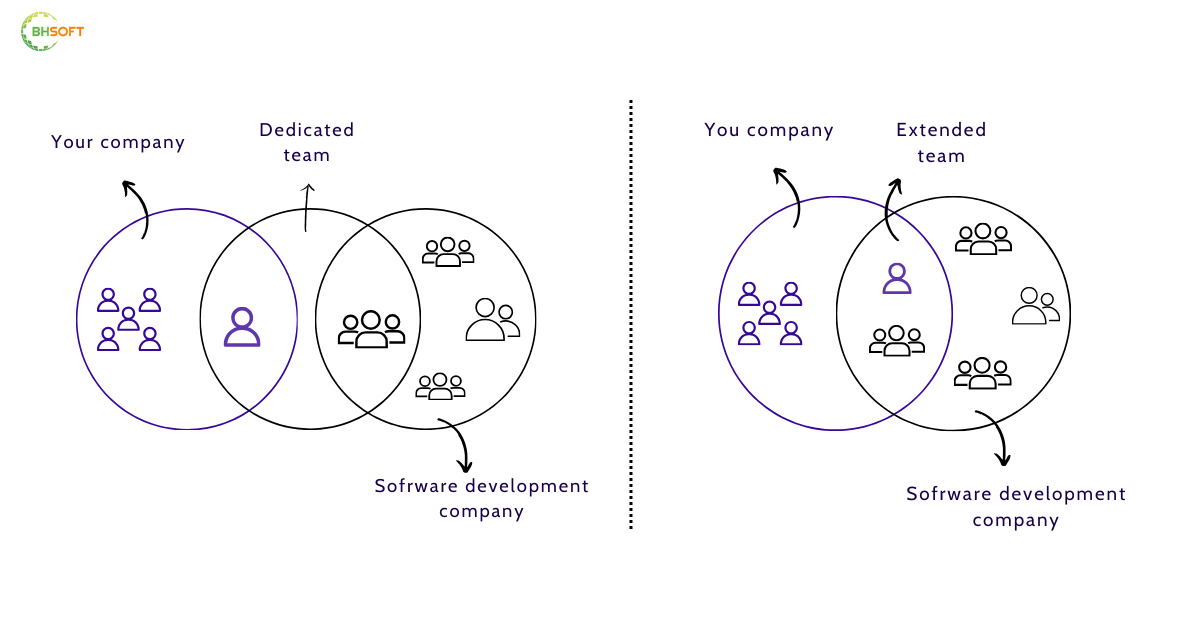
The dedicated development team model is a collaboration between a company and a software service provider, where the provider supplies a team of experts working full-time on a specific project for the company. Here are some key features of a dedicated team:
- A dedicated team works for one project or client.
- Team members work full-time, like internal employees.
- The provider manages recruitment, training, and performance evaluations.
- The company can adjust team size based on project needs.
You may be interested in: Hire Dedicated Developers: The Ideal Solution for CTOs in the Digital Age
Development team extension, on the other hand, supplies your existing team by filling gaps with external developers. These external experts work full-time, aligning with your company’s culture and goals.
This seems similar to the Dedicated Development Team model. The key difference is that a dedicated development team focuses solely on one project with a set timeframe, whereas a development team extension integrates into your company for ongoing work. It has functions like permanent employees.
Communication
In the dedicated development team model, communication is handled partially or entirely externally. Since the dedicated development team is to a specific project, they primarily focus on external collaboration with your business.
In contrast, the Development Team Extension model integrates external experts into your internal team. Therefore, communication occurs internally between core employees and the extended team.
Recruitment
For the Dedicated Development Team model, a software outsourcing company handles recruitment and selects the members for the dedicated team. While you can be involved, the provider ensures that the dedicated team has the expertise to deliver professional
With the Development Team Extension model, you can directly participate in the candidate selection process. You have the option to interview and choose individuals to join your internal team, ensuring a seamless fit.
Management and Control
In the Dedicated Development Team model, the outsourcing company is primarily responsible for managing and controlling the team. They independently manage their team and are accountable for a specific project.
In contrast, when you hire an extended team, you have full control and management of the group. Additionally, you will need to guide and train the extended team to meet your company's requirements.
Scope of Service
When you hire a dedicated development team, the project scope is tailored to your needs.
Meanwhile, the project scope when hiring a Development Team Extension is limited by the capabilities of your internal team.
Read more: How to Set Up and Run an Offshore Development Center
Key Benefits of Software Team Extension for Your Business
Why are thousands of fast-growing startups and enterprises leveraging software team extension? The business advantages are clear:
It allows access to new expertise and technology.
Development Team Extension allows to tap into a global talent pool and hire developers with specific skills. Companies that provide experienced professionals who bring the latest technology from their region, which your team may not have. In fact, 90% of businesses can take advantage of more outsourcing opportunities thanks to the cloud, which enables seamless connections with remote development teams.
It contributes to a significant cost reduction.
Companies based in developed countries pay high salaries when hiring their local software developers. With the Development Team Extension model, you can hire equally skilled developers from countries with lower labor costs, significantly reducing remuneration and operational expenses.
It's flexible
This model allows companies to easily scale their development teams according to project needs, minimizing the risks associated with hiring and firing employees. In addition, your developers can work from anywhere in the world and remain reachable thanks to the convenience of digital technology.
It helps time to market faster.
Software team extension is an ideal strategy if you're looking for quick project delivery. You can hire developers with the relevant expertise and spend less time and effort on onboarding. Consequently, product development will take less time than if you went through the regular hiring process.
Common Pitfalls When Hiring an Extension Partner
While the benefits are immense, poorly managed team extensions can lead to friction. Here are the common challenges and how to mitigate them:
Cultural Barriers
Development team extension teams may come from a different cultural background, potentially affecting communication and collaboration. Clear communication helps build strong relationships between teams, ensuring smoother collaboration. Promoting integration will reduce misunderstandings and improve the overall work process.
Management and Coordination
Managing two teams can be complex. You’ll need clear communication, onboarding, and project management tools for effective collaboration. Proper training ensures external experts understand your workflow.
Information Security
Sharing project information with third parties increases the risk of critical information being leaked, which can be detrimental to your company. You may have difficulty managing access. Giving team members extended access to your company's internal systems requires strong security measures to prevent unauthorized access.
Step-by-Step Process to Hire an Extended Development Team
To maximize the return on your investment, follow this structured process:
Step 1: Identify your needs
Every company has unique project requirements and business goals. Specify details such as the type of application you want to build and the necessary technology stack. Do you need someone to supplement your team and provide extensive support? If so, an experienced developer would be a better choice than someone relatively new to the industry.
Step 2: Search for suitable companies
The next step is to look for software outsourcing companies that meet your needs. You can do this by searching on websites, forums, and professional comparison sites like Clutch. Regardless of your choice, conduct due diligence by checking what other clients say about the respective software companies.
Step 3: Choose partners based on conditions and requirements
Only a few companies will meet the terms you've set, including rates, qualifications, skills, and communication methods. It’s crucial for developers to adhere to privacy and information security agreements. Create a list of potential partners that fulfill all your requirements.
Step 4: Contact partner
You will likely work closely with the hired team for an extended period, so take the time to connect with the partner to get to know each other better. During this conversation, you can discuss your project details and communicate your expectations. While doing so, assess their soft skills, which can be valuable when they join your team.
Step 5: Test the partner’s capabilities
Finally, assign the partner a trial task to ensure their capabilities align with what was presented on paper. This prevents hiring a partner who does not meet the specified skills.
The cost for a Development Extended Team
If you decide to use the Development Team Extension model, budgeting for hiring an extended team is essential. The budget size largely depends on the region where the developers are based. Salary levels for software developers can vary significantly between countries.
Country | Salary/ year |
United States | $110,140 |
Canada | $61,680 |
Australia | $55,640 |
Germany | $52,275 |
Singapore | $41,864 |
Japan | $36,024 |
China | $23,790 |
South Africa | $19,151 |
India | $7,725 |
Nigeria | $7,255 |
We have gathered data on the salaries paid to software developers in several countries in 2024. As you can see, developing countries like Nigeria pay the lowest at $7,255 per year. India, where many Western companies outsource their technical needs, has an average yearly salary of $7,725. Developers in Eastern European countries can also expect significantly lower salaries compared to their Western counterparts.
Feel free to contact BHSoft if you want more information about the cost of development team extension services from a leading software development company in Vietnam.
Comparison of Team Extension and Other Engagement Models
|
Model |
Team Extension |
Dedicated Team |
Freelancer |
|
Level of Control |
Full |
Medium |
Lowest |
|
Hiring Method |
Select individual developers |
Selected by the vendor |
Self-selected |
|
Level of Engagement |
High |
Lower |
Low |
|
When to Use |
When you need to add specific skills quickly |
When you need a separate, long-term project team |
When needs are short-term and flexible |
Checklist Before Hiring a Development Team Extension
Before signing a contract with an IT staff augmentation agency, check the following boxes:
Checklist: 7 Things You Should Not Skip
- Define the exact skills you need: Be clear about the roles, tech stack, seniority level, and expected experience. This helps avoid hiring developers who do not match your real needs.
- Check the partner’s hiring and vetting process: Ask how candidates are screened, tested, and interviewed. A reliable partner should have a structured process, not just CV filtering.
- Review communication skills and time zone overlap” Make sure the team can communicate clearly in English and work within time zones that fit your workflow.
- Set clear KPIs and performance tracking tools: Define how productivity, code quality, and delivery speed will be measured. Use tools like Jira, GitHub, or other project management platforms.
- Plan onboarding for the extended team: New team members need proper onboarding to understand your product, goals, and working style from day one.
- Confirm security and data protection standards: Check NDAs, access control, and data security policies to protect your source code and business information.
- Understand the engagement and exit terms: Clarify contract terms, team scaling options, and replacement policies in case a developer is not a good fit.
Onboarding and Team Integration for Development Team Extension
Hiring a development team extension is only the first step. To make it work long-term, strong onboarding and smooth team integration are critical. Many CTOs and tech leaders see this as a key factor before choosing a team extension model.
Helping New Team Members Understand Internal Processes
Extended developers need a clear view of how your company works. This includes coding standards, review processes, release cycles, and decision-making flows.
Using the Right Remote Communication Tools
Common tools include Slack for daily communication, Zoom or Google Meet for meetings, and Notion or Confluence for documentation. What matters most is setting clear rules on when and how each tool should be used, so no information is missed.
Building a Clear Sprint Rhythm for Distributed Teams
A shared working rhythm keeps everyone aligned. Set up regular sprint planning, daily stand-ups, sprint reviews, and progress reports. Keep meetings short and focused, and make sure extended team members are treated as part of the core team, not outsiders.
Accelerate Your Project with BHSoft’s Team Extension Services
Finding the right balance between cost, speed, and technical excellence doesn't have to be a challenge. At BHSoft, we specialize in providing top-tier Development Team Extension Services tailored to your exact project needs.
With a rich talent pool of pre-vetted developers, fluent English communication, and adaptable Agile workflows, we help you close your tech gaps and scale your digital products seamlessly.
Ready to scale your tech team the smart way? Contact BHSoft today for a free consultation and get access to top-tier developer resumes within 48 hours.